
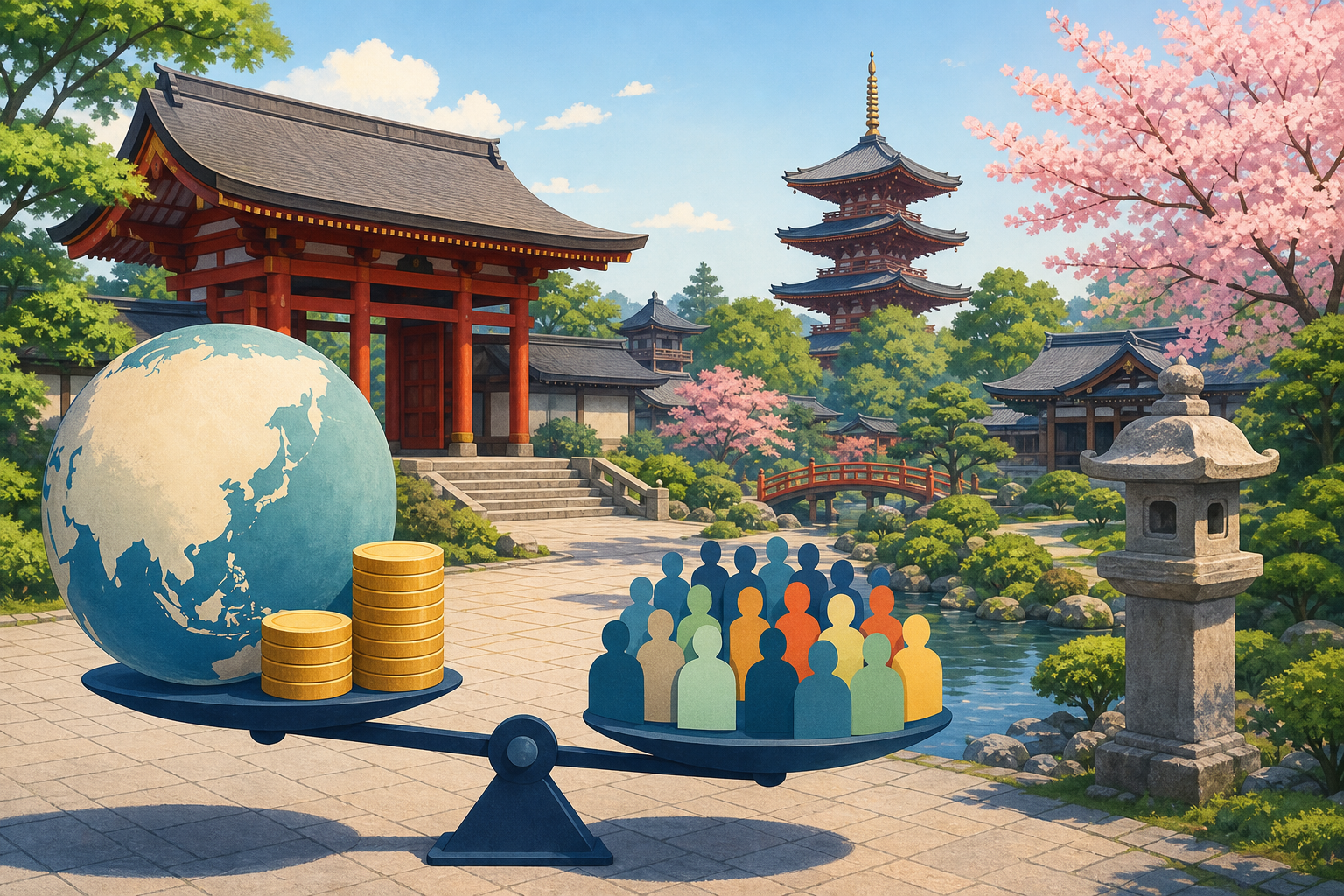
Japan welcomed a record 42.68 million international visitors in 2025, generating approximately ¥9.5 trillion in visitor spending. Tourism has brought substantial economic benefits, but the concentration of travellers in destinations such as Kyoto, Mount Fuji and Himeji has also intensified congestion, placed pressure on public services and affected the daily lives of residents. One increasingly controversial response is two-tier pricing: allowing local residents to pay less while other visitors pay a higher general admission fee. Japan has not introduced a nationwide foreign-tourist surcharge, but the debate over who should pay for preserving heavily visited destinations is becoming an important part of the country’s tourism policy.
Is Japan Introducing Nationwide “Foreigner Pricing”?
No nationwide rule currently requires foreign visitors to pay more at Japanese attractions. As of July 2026, individual cities, public facilities and private businesses remain responsible for setting their own prices.
The Japan Tourism Agency has begun studying how tourism facilities should set sustainable prices, including systems that distinguish between residents and non-residents. In March 2026, the agency said that formal guidance and its treatment of two-tier pricing were still under consideration. A research group examining pricing models held its first meeting on April 27, 2026.
This means reports claiming that Japan has introduced a universal dual-pricing system for all foreign tourists are misleading. What Japan is seeing instead is a growing collection of local experiments, resident discounts, entrance fees, reservations and visitor-management measures.
Himeji Castle: The Most Important Current Example
Himeji Castle introduced a new admission structure on March 1, 2026. General adult admission increased from ¥1,000 to ¥2,500, while adults who live in Himeji continue to pay ¥1,000. Visitors under 18 are admitted free, regardless of nationality or residence. Himeji residents must show acceptable proof of their local address to receive the discounted rate.
| Visitor | Admission from March 1, 2026 | Verification |
|---|---|---|
| General visitor aged 18 or over | ¥2,500 | No local-resident proof required |
| Himeji resident aged 18 or over | ¥1,000 | Proof of address required |
| Visitor under 18 | Free | Proof of age may be requested |
The policy is therefore based on residence, not nationality. A Japanese citizen visiting from Tokyo or Osaka normally pays the ¥2,500 general rate. A foreign citizen who legally resides in Himeji can qualify for the ¥1,000 city-resident rate by showing suitable identification, such as a residence card displaying a Himeji address.
Himeji City says the revised price was calculated around the expected cost of maintaining, repairing and preserving the castle over the next decade. Revenue is also intended to support improved visitor experiences, historical restoration, digital systems and services for inbound tourism.
During the first month after the new system began, admissions reportedly fell by approximately 17%, while revenue roughly doubled. That early result suggests higher prices may raise funds without completely discouraging tourism, although a single month is too short to determine the policy’s long-term effect.
Why the Language Used Matters
Calling Himeji’s policy a “foreigner surcharge” creates the impression that visitors are charged according to their passport. The official system is more accurately described as a local-resident discount combined with a higher general admission fee.
That distinction does not eliminate the controversy. Most overseas tourists will still pay the higher rate because they do not live in Himeji. However, the same rate applies to Japanese domestic tourists from outside the city. The policy is designed around the relationship between a municipal attraction and the residents whose city manages it, rather than around ethnicity or citizenship.
Clear wording also matters for fairness. A facility should explain:
- who qualifies for the discounted rate;
- which documents are accepted;
- why the general price is higher;
- how the additional revenue will be used;
- whether children, students or people with disabilities receive exemptions.
The Argument for Charging General Visitors More
Residents Already Support Local Infrastructure
Local residents contribute to their city through taxes and daily economic activity. They also live with the effects of tourism throughout the year, including crowded buses, blocked streets, noise and higher pressure on public facilities. A resident discount can recognise that continuing relationship.
Heritage Preservation Is Expensive
Historic buildings, natural areas and cultural sites require maintenance, specialised repairs, safety staff, multilingual information and visitor-management systems. When visitor numbers rise, maintenance requirements can rise with them. Charging enough to cover those costs may be more sustainable than keeping admission artificially low.
Low Prices Can Encourage Excessive Demand
A very low entrance fee may attract more visitors than a fragile or constrained site can comfortably manage. A higher price can reduce some low-priority visits while creating revenue that helps the attraction handle those who still attend.
Local Access Should Not Become Unaffordable
When a major attraction raises prices for everyone, families living nearby may lose access to their own cultural heritage. A resident rate allows a destination to increase tourism revenue without pricing its community out of regular visits.
The Argument Against Two-Tier Pricing
Visitors May Feel Unwelcome
Even when the distinction is based on residence, international visitors may interpret the system as a penalty directed at them. Poor explanations, aggressive identity checks or signs that focus heavily on foreigners can damage trust.
Price Alone Does Not Solve Crowding
A visitor willing to pay ¥2,500 may still arrive at the busiest hour, use the same crowded bus and stand in the same congested viewing area. Pricing can raise funds, but it does not automatically distribute tourists across different times or locations.
Domestic Travellers Also Pay More
A strict local-resident discount means Japanese travellers from other cities pay the general price too. That may be fair from a municipal perspective, but it can also make domestic tourism more expensive.
Verification Can Be Awkward
Resident discounts require identification checks. Staff need clear rules for Japanese residents, foreign residents, students, people who recently moved and visitors whose documents do not show a current address.
Additional Revenue Must Be Accountable
Travellers are more likely to accept a higher fee when the destination clearly shows that the money supports conservation, public transport, sanitation, crowd management or local communities. Without transparency, the increase can look like opportunistic pricing.
Japan Is Using More Than One Overtourism Strategy
The national government’s stated approach is to balance tourism with residents’ quality of life and visitor satisfaction. It supports local measures rather than imposing one identical system across the country. These measures can include improved transport, luggage services, reservations, visitor caps, educational campaigns and dispersing tourists to less crowded areas.
Mount Fuji Uses a Universal Hiking Fee
Mount Fuji demonstrates an alternative to resident-versus-visitor pricing. During the 2026 climbing season, all four main routes require a ¥4,000 hiking fee. The fee applies per person and per climb, regardless of nationality. The Yoshida Trail also has a daily limit of 4,000 climbers and restricts entry between 2:00 p.m. and 3:00 a.m. for climbers without mountain-hut accommodation.
This model charges people according to their use of the mountain rather than their place of residence. Revenue supports environmental protection, safety measures, trail management and multilingual assistance.
Kyoto Focuses Heavily on Behaviour and Dispersal
Kyoto’s official tourism guidance reminds visitors that many attractions are located beside homes and working neighbourhoods. The city asks both tourism businesses and visitors to consider how their behaviour affects residents. Kyoto also promotes responsible travel, less crowded areas, luggage services and visits outside peak periods.
This matters because overtourism is not simply the presence of international visitors. It usually involves too many people being concentrated in the same place, at the same time, while using infrastructure that was not designed for that level of demand.
What Would Make Two-Tier Pricing Fairer?
A responsible pricing system should meet several conditions.
- Base discounts on residence rather than nationality. A residency model is easier to justify because it connects the discount to local taxes and community participation.
- Explain the purpose clearly. Visitors should be told whether the additional money funds preservation, transport, staffing or other specific needs.
- Apply transparent rules. Accepted documents, age limits and exemptions should be published before visitors arrive.
- Protect access for young people. Free or reduced admission for children and students can prevent cultural sites from becoming accessible only to wealthy travellers.
- Combine pricing with reservations. Timed tickets and daily limits manage congestion more directly than price increases alone.
- Publish results. Destinations should report how visitor numbers, revenue, maintenance and resident satisfaction change after a new system begins.
- Avoid humiliating checks. Verification should be discreet, consistent and available in multiple languages.
What Travellers Should Expect
Visitors should not assume that every Japanese attraction charges foreigners more. Most attractions still publish one standard admission price, while some offer discounts based on age, disability, residence, advance booking or combination tickets.
Before visiting a heavily travelled destination:
- check the attraction’s official website rather than relying on social-media summaries;
- confirm the current admission price and accepted payment methods;
- check whether reservations or timed entry are required;
- read the exact eligibility rules for resident or student discounts;
- visit early, late or on a weekday when possible;
- look for official crowd information before travelling;
- consider nearby attractions rather than following only the most popular route.
Travel Etiquette Matters as Much as Pricing
Higher prices may fund infrastructure, but individual behaviour still shapes the relationship between visitors and residents. Respectful travel does not require perfect knowledge of every Japanese custom. It requires attention to the fact that tourist destinations are also places where people live and work.
Do Not Block Residential Streets
Pause for photographs only where it is safe. Avoid standing in roadways, private entrances or narrow lanes used by residents and delivery vehicles.
Respect Photography Restrictions
Do not photograph people, private property, religious ceremonies or restricted areas without permission. A street being visible from a public road does not make every person on it a tourist attraction.
Keep Noise Under Control
Speak quietly on residential streets, public transport and at sacred sites. Large groups should take particular care not to overwhelm small spaces.
Follow Queues and Staff Instructions
Join the end of the line, keep entrances clear and follow one-way routes or timed-entry instructions. These systems often exist to protect both the site and its visitors.
Carry Your Rubbish
Public bins can be limited. Carry a small bag for wrappers and bottles until you find an appropriate disposal point.
Travel With Manageable Luggage
Large suitcases increase crowding on buses, narrow streets and station platforms. Use lockers, hotel forwarding or luggage-delivery services when practical.
Useful Japanese Phrases for Tickets and Crowded Places
| Japanese | Reading | Meaning |
|---|---|---|
| 入場料はいくらですか? | Nyūjōryō wa ikura desu ka? | How much is admission? |
| 一般料金はいくらですか? | Ippan ryōkin wa ikura desu ka? | How much is the general admission fee? |
| 市民料金はありますか? | Shimin ryōkin wa arimasu ka? | Is there a city-resident rate? |
| どの身分証明書が必要ですか? | Dono mibun shōmeisho ga hitsuyō desu ka? | What identification is required? |
| 予約が必要ですか? | Yoyaku ga hitsuyō desu ka? | Is a reservation required? |
| 今、混んでいますか? | Ima, konde imasu ka? | Is it crowded now? |
| 写真を撮ってもいいですか? | Shashin o totte mo ii desu ka? | May I take a photograph? |
| すみません、通ります。 | Sumimasen, tōrimasu. | Excuse me, I am coming through. |
| わかりました。ありがとうございます。 | Wakarimashita. Arigatō gozaimasu. | I understand. Thank you very much. |
When asking about a price difference, a neutral question is usually more natural than directly asking why foreigners are charged more. For example, 料金について教えてください—Ryōkin ni tsuite oshiete kudasai—means “Please tell me about the pricing.”
A Short Practice Dialogue
Visitor: すみません。入場料はいくらですか?
Sumimasen. Nyūjōryō wa ikura desu ka?
Excuse me. How much is admission?
Staff member: 一般料金は二千五百円です。市民料金は千円です。
Ippan ryōkin wa nisen gohyaku-en desu. Shimin ryōkin wa sen-en desu.
General admission is ¥2,500. The city-resident rate is ¥1,000.
Visitor: 市民料金には身分証明書が必要ですか?
Shimin ryōkin ni wa mibun shōmeisho ga hitsuyō desu ka?
Is identification required for the city-resident rate?
Staff member: はい、住所が確認できる証明書が必要です。
Hai, jūsho ga kakunin dekiru shōmeisho ga hitsuyō desu.
Yes. You need identification that confirms your address.
Visitor: わかりました。ありがとうございます。
Wakarimashita. Arigatō gozaimasu.
I understand. Thank you very much.
Frequently Asked Questions
Does Japan charge all foreign tourists more?
No. Japan does not currently have a nationwide rule requiring foreign tourists to pay higher attraction fees. Prices are decided by individual cities, attractions and businesses.
Does Himeji Castle charge according to nationality?
No. It charges a ¥2,500 general adult rate and offers a ¥1,000 rate to verified Himeji residents. The discount is based on residence rather than nationality. Visitors under 18 enter free.
Is two-tier pricing legal in Japan?
Facilities generally have substantial freedom to set prices, but policies must still comply with applicable consumer, contractual and anti-discrimination rules. The Japan Tourism Agency is studying pricing practices and has not yet introduced one nationwide model.
Are higher prices the main solution to overtourism?
No. Pricing can fund preservation and potentially reduce demand, but reservations, visitor caps, improved transport, regional dispersal, luggage management and clearer etiquette guidance often address crowding more directly.
Should Visitors Pay More Than Residents?
A local-resident discount can be reasonable when residents help support a public attraction, live with tourism’s effects and might otherwise be priced out of their own heritage. Himeji’s policy is stronger than a nationality-based surcharge because it applies one general rate to all non-residents and clearly states that the additional money will support the castle’s preservation and operation.
However, higher prices should not become an excuse to ignore congestion, poor planning or inadequate infrastructure. A destination can collect more money while remaining overcrowded. Pricing works best when it is transparent, connected to measurable improvements and combined with reservations, capacity controls and efforts to spread visitors across different locations and times.
For travellers, the most constructive response is not unquestioning acceptance or immediate outrage. Check what the policy actually says, distinguish nationality from residency, ask questions politely and judge whether the system is clear and accountable.
Japan’s overtourism debate is ultimately about more than ticket prices. It is about whether tourism can remain economically valuable without making daily life harder for residents or damaging the places people have travelled to experience. The most sustainable answer will likely involve a mixture of fair pricing, better management and more considerate travel.
Sources
- Japan National Tourism Organization: 2025 visitor numbers and tourism spending.
- Japan Tourism Agency: national overtourism policies and support measures.
- Japan Tourism Agency: research into tourism-facility pricing and two-tier systems.
- Himeji City: official March 1, 2026 admission fees and resident-discount requirements.
- Official Mount Fuji climbing website: 2026 hiking fees, limits and entry rules.
- Kyoto City Official Travel Guide: responsible-tourism guidance.


